

Researchers Develop Battery-Free Sensor Powered by Ambient Radiation
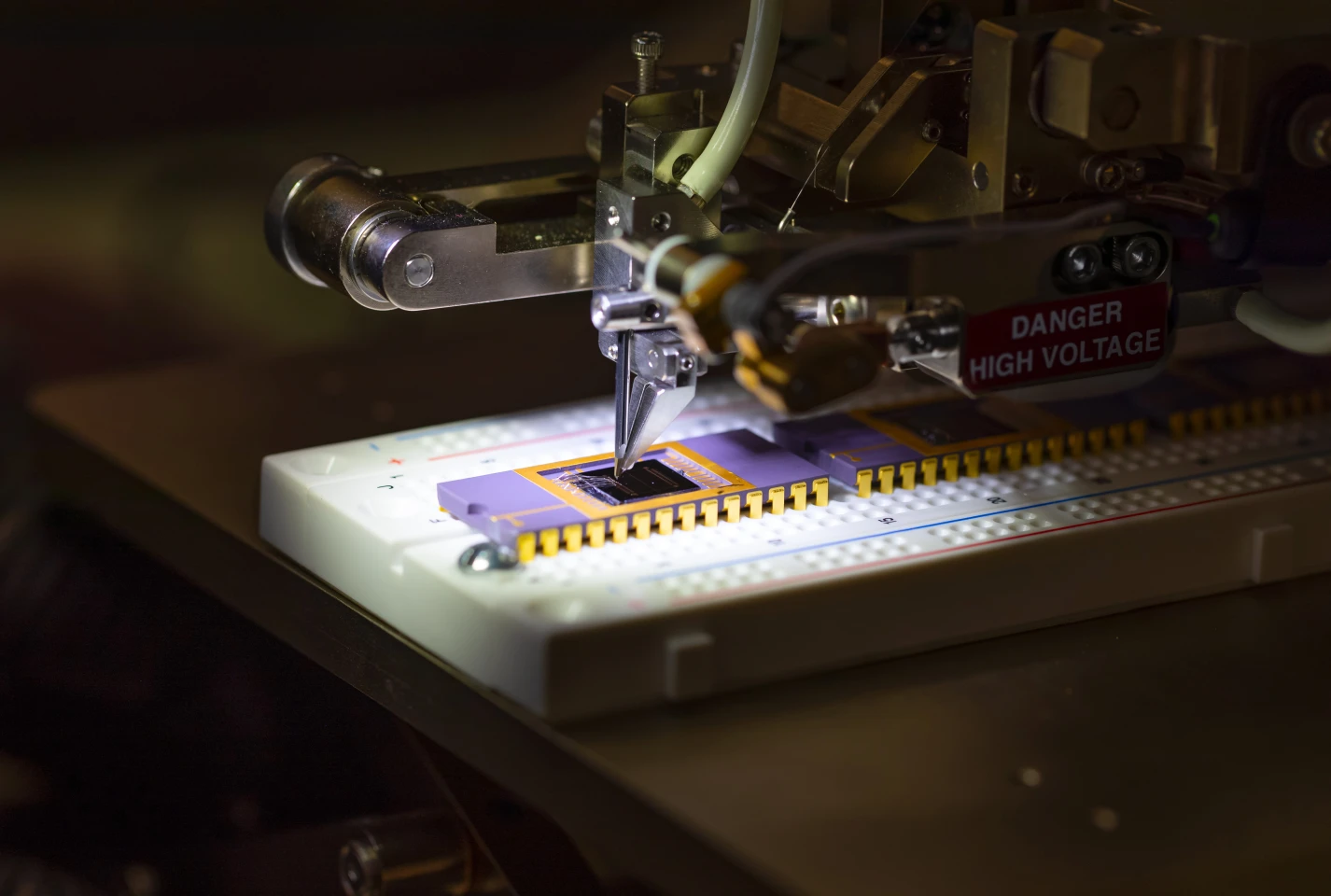
Scientists at the University of Arkansas and the University of Michigan have developed a graphene-based energy harvester that generates electricity by harnessing ambient radiation from nearby electrical wiring.
This technology was demonstrated through a battery-free temperature-sensing system, which includes the energy harvester, power conversion circuitry, energy-storage capacitors, and an ultra-low-power temperature sensor. The system operates wirelessly, generating the electricity needed to power the sensor via electromagnetic induction.
Ambient radiation from electric wiring powers the device by utilizing the magnetic field generated by electric current flowing through a wire. In the United States, this occurs at 60 Hz (60 cycles per second). The researchers captured some of that energy and converted it into electricity sufficient to power a tiny temperature sensor.
To achieve this, they fabricated an inductor from graphene and incorporated a steel core to enhance its ability to capture the magnetic field. When placed near a power cable, the fluctuating magnetic field induces a tiny alternating voltage across the inductor, a principle similar to that of conventional transformers and generators.
However, this tiny electrical signal is not immediately useful for powering electronic components. It is alternating current (AC), while the sensor requires direct current (DC), and its voltage is too low for reliable power. To address this, the researchers developed a circuit based on a Cockcroft-Walton voltage multiplier that rectifies the AC signal into DC and increases its voltage to suitable levels for the sensor.
Instead of using a conventional rechargeable battery, the system stores the harvested electricity in three capacitors, which gradually accumulate electrical charge. The researchers claim that the harvester replenishes the stored energy faster than the temperature sensor consumes it.
Despite the modifications, the electricity remains too low to power standard electronics. To overcome this limitation, the researchers designed a custom ultra-low-power temperature-sensing system that operates at the nanowatt scale, consuming just billionths of a watt. This consumption is approximately 30 million times less power than a single AirPod.
Although the graphene inductor harvests energy slowly, it can replenish the capacitors faster than the sensor drains them. This allows the system to operate as long as sufficient electromagnetic energy is available. The capacitors can store excess energy, enabling the sensor to function even when the nearby electricity supply is interrupted. The researchers estimate that the stored charge could keep the sensor running for at least 24 hours, potentially up to a week.
Prof. Paul Thibado, the inventor of the graphene energy harvester, stated, “The inductor adds charge to these capacitors at a slow rate, but it’s faster than the rate the sensor uses up the charges from the capacitors. So even if the power went out, it can still pull a charge from the capacitors. The way ours are set up, it can easily last 24 hours – probably a week even.”
The researchers created a temperature-sensing system that operates on a minimal amount of electricity drawn from ambient radiation by a dedicated graphene energy harvester. As long as there is electricity in nearby wiring, the standalone system can continue its temperature-sensing duties indefinitely.
This system could be particularly useful in large industrial facilities with numerous temperature sensors monitoring machinery, pipes, and the environment. Typically, these sensors require wired power supplies or batteries that need replacement. The researchers’ device allows multiple sensors to function without any wires or the need for recharging.
However, there are limitations to consider. The harvester requires sufficiently strong changing magnetic fields near electrical wiring and has not been demonstrated to start from a completely discharged state. Additionally, the system’s nanowatt output is only adequate for the dedicated sensor.
While the researchers are currently focused on temperature sensors as a proof of concept, they envision the system’s application in various low-power sensors for uses such as product tracking, atmospheric monitoring, logistical fleet management, soil and wearable fitness monitoring, and medical tracking.
The team is also exploring ways to harvest electricity from other sources, including acoustic, nonlinear, solar, thermal, kinetic, and ambient radiation, aiming to develop autonomous sensor systems powered by multiple environmental sources.
A paper detailing the study was published in the Journal of Vacuum Science and Technology.
Source: New Atlas