

Self-Sensing Artificial Muscles From Liquid Crystal Elastomer With Graphene
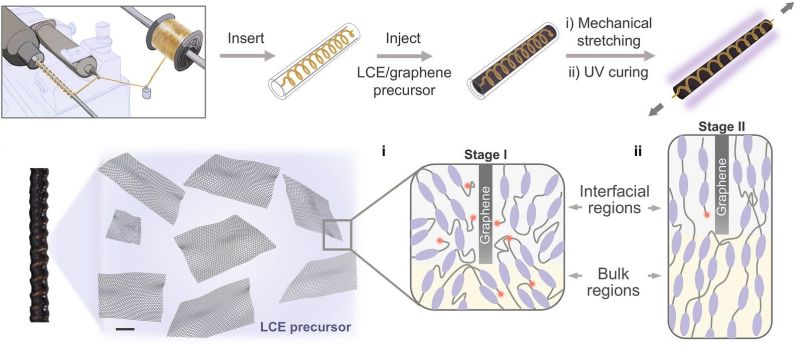
Researchers have introduced self-sensing artificial muscles made from liquid crystal elastomers (LCEs) combined with graphene, showcasing their potential for fine control in robotic applications. This innovation highlights the versatility of artificial muscles, which have traditionally struggled to replicate the precision of small human muscles.
The study, led by Ziyun Zhang and colleagues, presents a novel approach utilizing LCE-graphene composite fibers. These fibers incorporate a thin copper heating coil embedded within the artificial muscle, enabling a closed-loop system with multistage actuation. The inclusion of graphene enhances the material’s toughness and thermal conductivity, addressing some limitations of earlier technologies.
To achieve self-sensing capabilities, the researchers measured the resistance of the copper coil, which varies with temperature. This method proved to be accurate within approximately 2%. The performance of these artificial muscles was demonstrated through applications such as a robotic hand playing a toy piano and a model simulating human eye movements.
While the current design may not be the fastest or most convenient due to the need for efficient cooling after heating, it represents a promising step forward in the use of LCEs for delicate tasks requiring precise control.
Source: Hackaday