

BepiColombo Successfully Enters Mercury Orbit After Eight-Year Journey
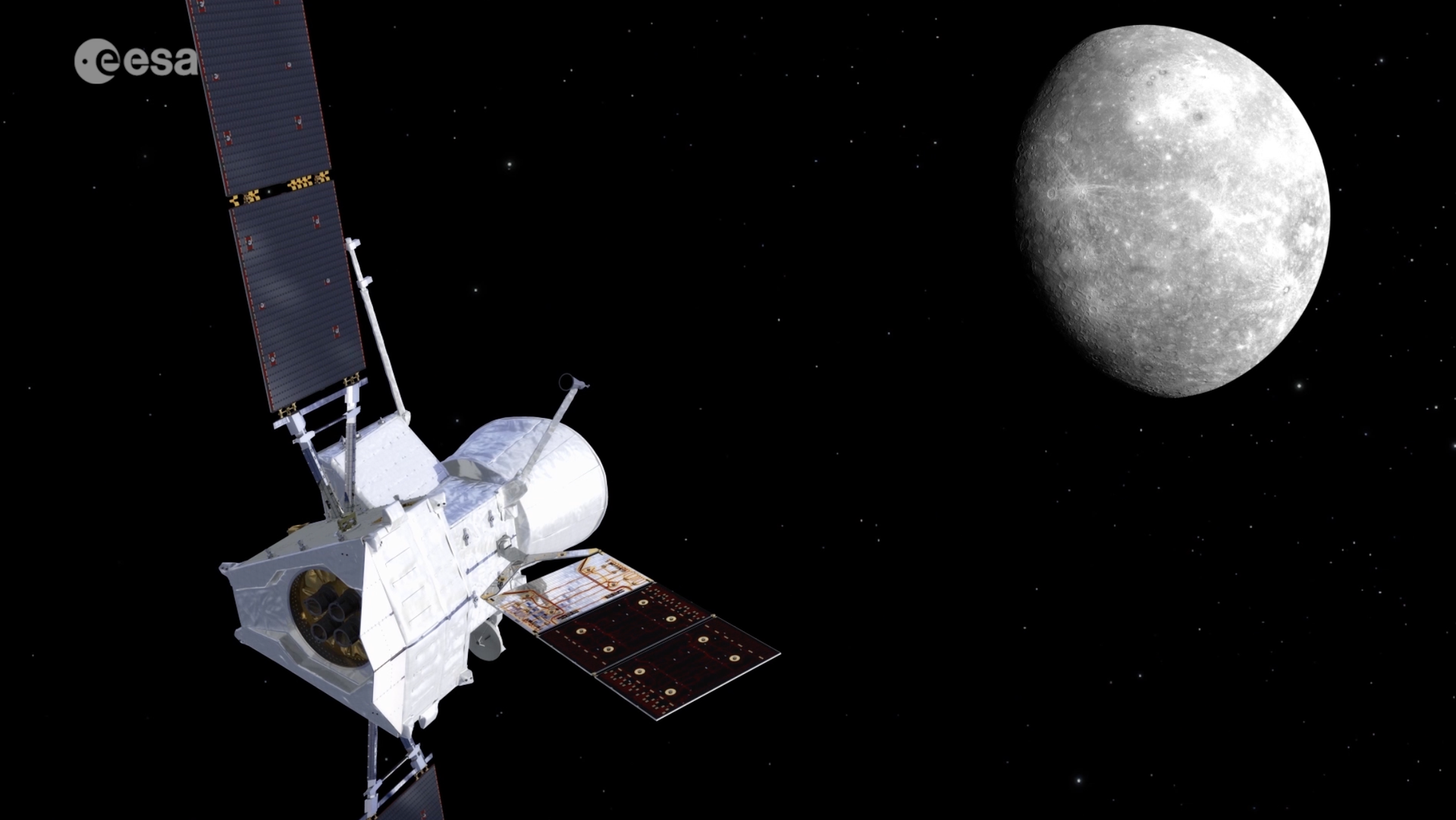
After an eight-year journey through the inner solar system, the joint European-Japanese spacecraft BepiColombo has successfully entered orbit around Mercury, marking it as only the second mission to achieve this feat.
Mission scientists confirmed on November 21 that the spacecraft reached Mercury’s orbit and is now transmitting data back to the ground team.
However, the orbital insertion did not go entirely as planned. Representatives from the European Space Agency (ESA) stated on Monday that a software glitch prevented the spacecraft from firing its thrusters for the full 37 minutes needed to slow its approach to Mercury.
Despite this issue, ESA noted that BepiColombo remains “safe” as they investigate the implications for the spacecraft’s trajectory. The spacecraft is expected to begin a year of intensive scientific observations of Mercury in a few months.
BepiColombo’s Space Odyssey
BepiColombo, built collaboratively by ESA and the Japan Aerospace Exploration Agency (JAXA), consists of two separate probes stacked one atop the other in orbit. The ESA-built Mercury Planetary Orbiter (MPO) and the JAXA-built Mercury Magnetospheric Orbiter (Mio) carry distinct scientific instruments and will soon diverge into separate orbital paths around Mercury, gathering different streams of data.
The probes launched together aboard an Ariane 5 rocket in October 2018 and spent the subsequent eight years on an interplanetary journey that included flybys of Earth, the moon, and Venus, as well as six flybys of Mercury itself. During one of these flybys in January 2025, BepiColombo captured an incredible closeup photo of Mercury’s north pole.
This complex trajectory was necessary to prevent BepiColombo from gaining too much speed and overshooting Mercury’s orbit, as Mercury is located about 36 million miles (58 million kilometers) from the sun, roughly one third of the distance between Earth and the sun. This proximity makes it challenging for spacecraft to reach Mercury without being captured by the sun’s strong gravitational pull.
Only one other spacecraft, NASA’s MESSENGER probe, has successfully entered Mercury’s orbit, circling the planet from 2011 to 2015 after its own seven-year journey.
What Will BepiColombo Study Now?
Assuming ESA confirms that BepiColombo is fit to continue its mission, the spacecraft will spend the next few months positioning both probes to begin mapping Mercury in unprecedented detail.
MPO and Mio are expected to separate in early December, with Mio entering a highly elliptical orbit around Mercury’s poles. MPO will then adjust its trajectory over the following months, reaching a lower and more circular polar orbit by March 2027, according to ESA. Science operations are anticipated to commence in April.
- Mercury may have shrunk much more than we thought, new study hints
- Mercury is weird because of a ‘hit-and-run’ incident in its youth
- Mercury’s ‘missing’ meteorites may have finally been found on Earth
The sibling probes will orbit Mercury several times a day, with MPO completing an orbit approximately every 2 hours. By observing the planet from various angles, the probes will create the most comprehensive map of Mercury to date. Their scientific instruments will study the planet across the electromagnetic spectrum, including X-rays, gamma-rays, and ultraviolet light, while also measuring the planet’s magnetic field.
With this data, scientists aim to unravel many mysteries surrounding the least-explored planet in the solar system. This new information will help address longstanding questions about Mercury’s interior composition, the origin of its magnetic field, its formation, and its current tectonic activity. Additionally, a radio experiment will provide a new test of Einstein’s theory of general relativity through precise measurements of the spacecraft’s orbit and position.
Further updates from ESA regarding humanity’s first visit to Mercury in over a decade are anticipated.
Related link: x.com
Source: Live Science