GitHub and Microsoft Focus on Delivering AI-Generated Security Fixes for Open Source Projects
AI has accelerated the identification of potential vulnerabilities, but fixing them requires human judgment, which falls on maintainers in the open-source community. Many maintainers are overwhelmed by AI-generated findings, which often include duplicates and irrelevant reports. To assist them, GitHub and Microsoft initiated a pilot project to determine if AI could help deliver fixes rather than just findings.
Using Codename MDASH, Microsoft’s multi-model scanning tool, the initiative aimed to identify and rectify security vulnerabilities in widely used open-source software.
The Process
The pilot had two primary objectives: to deliver significant findings and ensure no unverified findings were sent to maintainers. The process involved:
- Find. Codename MDASH scanned each project using Microsoft’s MAI Cyber model and suggested fixes for identified issues.
- Filter. An AI triage agent from the GitHub Security Lab eliminated duplicates, validated findings, and focused on high-impact bugs.
- Verify. Researchers from Microsoft FORGE Lab manually reviewed every remaining finding.
- Report privately. Reports were delivered to maintainers through GitHub’s private vulnerability reporting system, including a proof of concept and suggested fixes.
- Fix. Maintainers determined what to fix, how to fix it, and when to implement the changes.
As a result, Codename MDASH identified thousands of potential issues across six projects. Following AI triage and manual review, maintainers received 99 private reports, with 55 issues resolved by November 15, including 14 fixes in a release.
Participating Projects
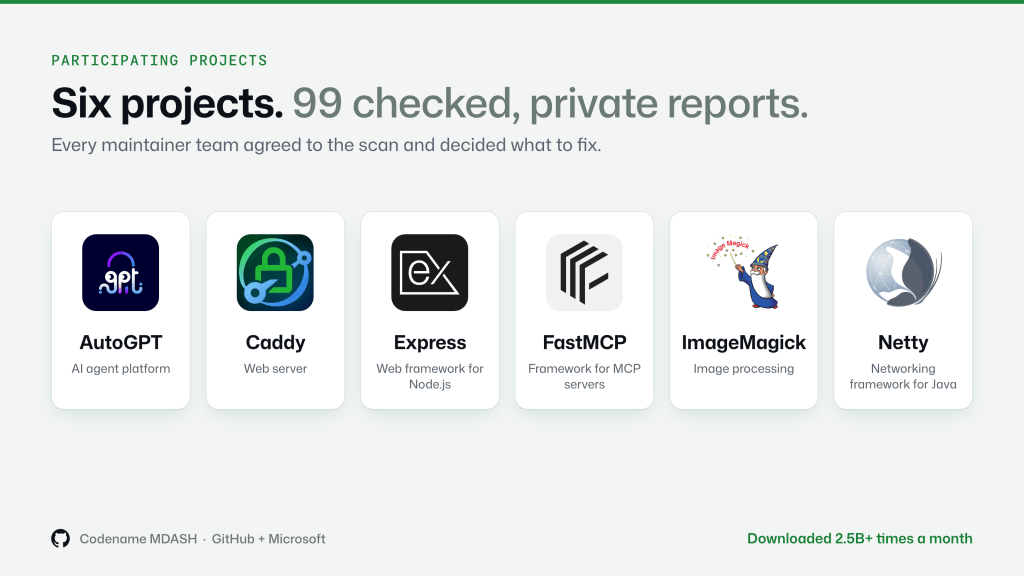
Six projects participated in the pilot, all alumni of the GitHub Secure Open Source Fund:
- AutoGPT
- Caddy
- Express
- FastMCP
- ImageMagick
- Netty
What We Learned
The pilot provided valuable insights, particularly regarding the importance of fixes over findings. Maintainers received reports with suggested fixes, enabling them to address issues quickly. For instance, Caddy’s maintainers resolved all 22 reports within a week, while AutoGPT’s maintainers implemented a fix within a day.
Finding vulnerabilities is no longer our bottleneck. Fixing them is the hard part, and that depends on maintainers.
Netty maintainer
Codename MDASH provided high-quality findings, allowing maintainers to focus on significant issues without being overwhelmed. Reports were concise, cutting through the noise of previous outputs.
Codename MDASH was able to find unknown, obscure security bugs in our project with succinct reports.
Caddy maintainer
However, the approach does not yet scale effectively, as manual verification remains labor-intensive. Low-quality reports continue to flood maintainers, highlighting the need for private vulnerability reporting and CI/CD tests on private forks.
Why It Matters
This approach reduces the time maintainers spend on security reports. A verified report with a suggested fix allows maintainers to focus on implementation rather than triage.
- Verify every finding before sending it.
- Report findings privately.
- Include a suggested fix.
What Happens Next
- Fixes, where maintainers already work. GitHub is applying these lessons to private vulnerability reporting and security advisories.
- MAI Cyber 2. Microsoft announced MAI Cyber 2, continuing collaboration with GitHub to enhance open source security.
- Closing the gaps. Efforts are underway to scale researcher review without compromising quality, providing AI security scans to every alumni project.
Source: GitHub Blog