

iFixit Tears Down iPhone Duo, Finds Possible Causes of Early Screen Failures
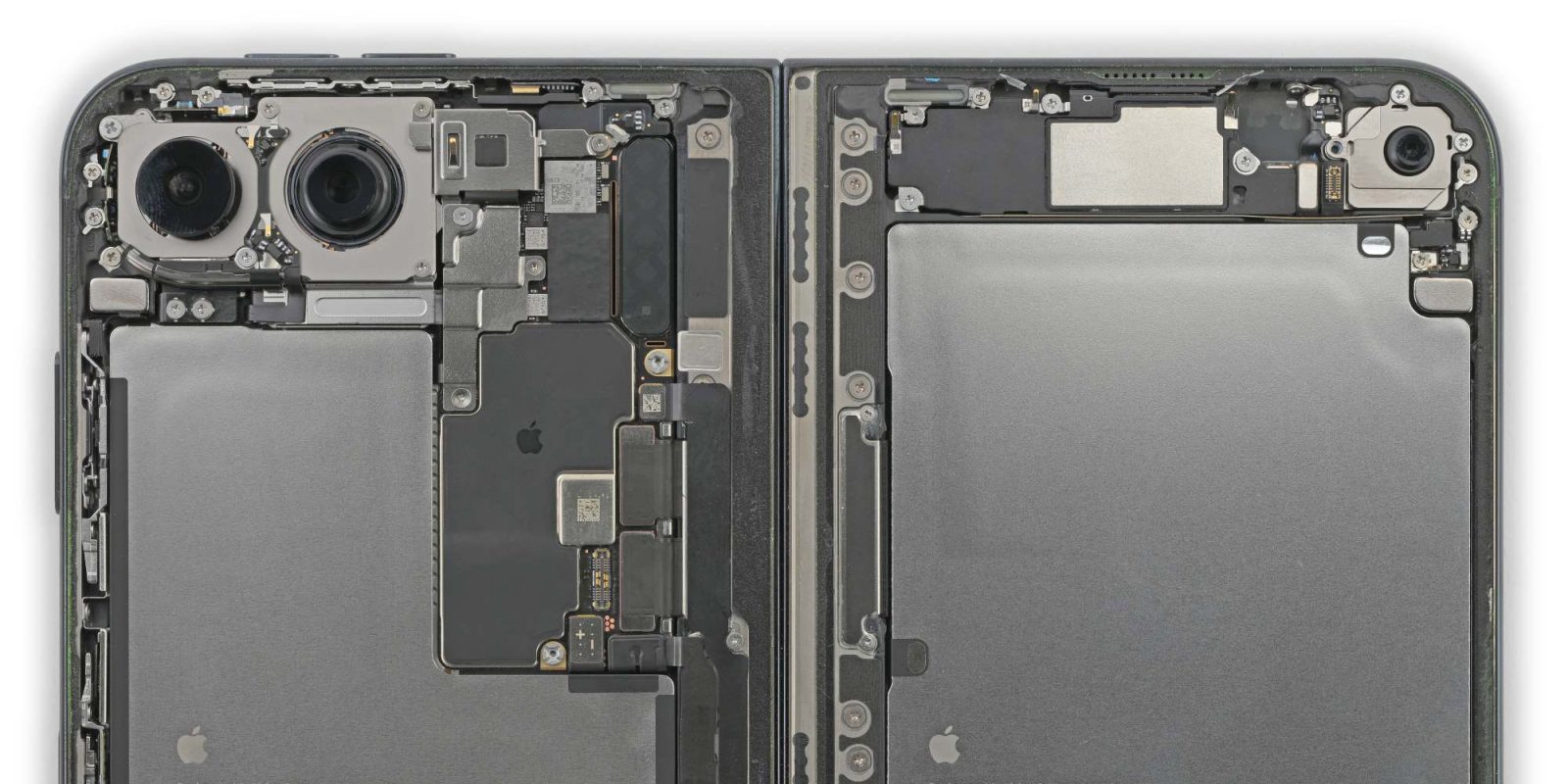
iFixit has completed its teardown of the iPhone Duo, revealing both promising and concerning details about what it describes as the most repairable foldable phone to date.
The iPhone Duo received a repairability score of 5 out of 10, the highest score iFixit has awarded to any foldable smartphone. This score is provisional, pending the availability of replacement parts, but it indicates a positive step for Apple’s first foldable device.
The teardown focuses heavily on the hinge mechanism, which is a significant aspect of the iPhone Duo. iFixit notes that Apple’s patents had hinted at the design for years, but the teardown reveals a more complex mechanism than previously anticipated.
iFixit began the teardown with its standard fluorescent dust test, allowing the team to observe how dust particles enter the device during disassembly. The iPhone Duo boasts an IP68 rating, meaning it is dust-tight and can withstand submersion in water up to 6 meters for 30 minutes.
Interestingly, after the dust test, the hinge began to produce crunchy sounds, although relatively little dust had entered it compared to other foldable phones. The hinge features a combination of gears, springs, and metal joints, along with a waterdrop design that allows the display to bend without excessive folding.
Potential Causes of Screen Failures
iFixit has identified possible causes for the early screen failures reported by some iPhone Duo users, who have described hearing a crunch while folding or unfolding the device, followed by bright lines appearing on the inner display.
The failures seem to occur near the area where the cable connects the two halves of the display and the central hinge support. Using CT scans and teardown footage, iFixit created a 3D model of the hinge to explore potential damage causes.
One theory suggests that a central support bar may not retract properly when the phone closes, potentially exerting excessive pressure on the display. Another possibility involves the curved rails guiding the hinge movement, which could interfere with the screen if they do not function correctly.
iFixit also noted that several structural components converge around the affected area, which could concentrate stress on the delicate display layers. While the teardown does not definitively pinpoint the cause of the failures, the similarities between the reported damage and the hinge’s internal structure offer promising leads for further investigation.
Additional Findings
The teardown also examined the iPhone Duo’s matte nano-texture display, designed to minimize the appearance of the crease by scattering reflected light. Under a microscope, iFixit found tiny rounded bumps on the surface that help diffuse reflections.
Another notable discovery was the arrangement of some subpixels, which are oval-shaped and oriented in different directions. An Apple patent suggests this design could reduce diffraction artifacts, making the crease less noticeable.
iFixit also analyzed the area above the inner display’s selfie camera, which uses a modified pixel pattern with larger gaps to allow light to reach the camera. In this region, the pixels are rounder and more uniformly arranged.
Additionally, the bezel surrounding the inner screen can be removed without damage, thanks to Apple’s use of clips instead of adhesive. The outer display is also relatively easy to remove, which is beneficial for internal repairs.
Regarding the batteries, iFixit detailed how Apple positioned the two cells, one beneath the back glass and the other under the outer display. The larger battery has a capacity of 11.567 Wh, while the smaller one is rated at 7.506 Wh, totaling 19.073 Wh.
iFixit praised Apple’s use of electrically releasable adhesive on both batteries, allowing for easy removal without excessive force. The teardown also delves into the iPhone Duo’s new logic board design and the display’s multiple layers, which move independently to accommodate folding.
For a complete look at the teardown, iFixit has provided a detailed blog post.
Source: 9to5Mac