

When Decoupling Capacitors Go Wrong
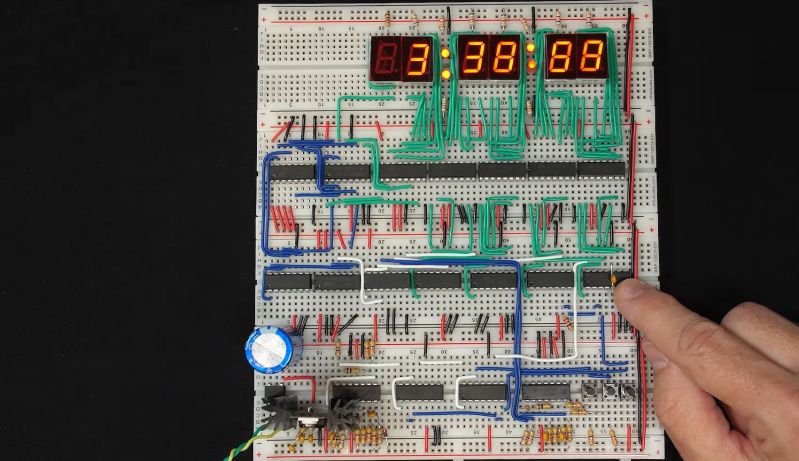
Ben Eater recently addressed a common misconception in electronics regarding decoupling capacitors, which are often believed to be beneficial in unlimited quantities. In his latest video, he explores the unintended consequences of adding these components, particularly when they lead to unstable power supply rails that begin to oscillate.
After receiving feedback from a viewer, Eater replicated the issue and discovered that the instability was due to a missing direct ground path for a large electrolytic capacitor connected to a 7805 5V voltage regulator. Instead of a straightforward connection, the ground took a convoluted route through extensive wiring and segments of a breadboard, introducing significant inductance.
This situation is comparable to a tank circuit, where the combination of an inductor and capacitor can create resonance. While resonance can be advantageous in certain applications, in this case, it resulted in excessive noise on the supply lines, which was amplified by the nearby decoupling capacitors.
Eater emphasizes the importance of placing input and output capacitors as close as possible to voltage regulators. In this specific instance, ensuring a single ground wire between the regulator and the electrolytic capacitor’s ground resolved the decoupling issue.
For those interested in the technical details, Eater’s full explanation can be found in his video, which further elaborates on the nuances of decoupling capacitors and grounding.
Source: Hackaday