

Innovative Method for Capturing and Mineralizing Atmospheric Carbon Dioxide
Recent concerns about elevated levels of carbon dioxide (ثاني أكسيد الكربون) in the atmosphere have led to innovative approaches for capturing and mineralizing this greenhouse gas. Despite fears of excessive CO2, Earth’s atmosphere remains composed of approximately 78% nitrogen and 21% oxygen, with carbon dioxide present at about 400 parts per million (ppm).
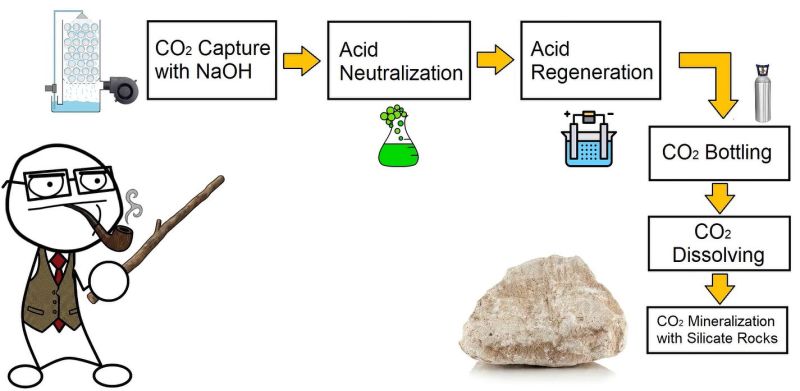
A recent video by Hyperspace Pirate explores a method for converting CO2 into a more stable solid form. This approach diverges from traditional calcium-based methods, instead utilizing sodium hydroxide as the capturing liquid. The process initially produces sodium carbonate, which is then converted to sodium bicarbonate.
To complete the mineralization process, the captured carbon dioxide must be released using sulfuric acid. This acid is regenerated through a cation exchange membrane-based cell, a technique previously covered by Hackaday.
The final step involves mineralizing the carbon dioxide using crushed wollastonite, which is introduced at high pressure and temperature to expedite the reaction. In this experiment, a total of 4.3 grams of carbon dioxide was successfully removed from the atmosphere, equivalent to approximately 2 liters.
While direct air capture of carbon dioxide is currently seen as economically unfeasible, the video highlights the challenges of scaling up this experimental method. The economics of carbon capture and storage (CCS) at pollution sources are also questioned, as they remain uncertain but are considered more viable than direct air capture.
For further insights, viewers can watch the full demonstration in the linked video.
Source: Hackaday