

Building trust in AI agents: A production-ready evaluation framework with Amazon Bedrock AgentCore
The North Star
Organizations deploying AI agents often face a critical challenge: while an agent may perform well in demonstrations, its performance can degrade in production without immediate detection. Unlike traditional software that fails visibly, AI agents can provide incorrect answers that appear confident and fluent, leading to potentially damaging business decisions. This erosion of trust can have significant consequences, as it can damage relationships with users.
The core issue is ensuring that agents not only function correctly at launch but continue to perform reliably at scale across all sub-agents, workflows, and releases. Successful teams will recognize quality as an ongoing process rather than a final quality assurance step. In this article, we demonstrate how to establish a continuous quality loop for production-ready AI solutions using Amazon Bedrock AgentCore.
Business Problem
The solution leverages Amazon Bedrock AgentCore and other AWS services to enable sellers and sales leaders to pose business questions in plain English through Amazon Quick. This integrated experience relies on several specialized sub-agents, including the Performance Insights Agent for revenue and performance analysis, the Customer Insights Agent for customer intelligence, and the Data Insights Agent for text-to-SQL queries on foundational datasets. Each answer is tailored to the user’s territory and role-level security, as accurate data is crucial for planning account strategies and preparing for customer meetings.
During pre-launch evaluations of the Customer Insights Agent, significant errors were identified, including:
- Misreporting a customer’s three-month revenue as “410.08 Million” instead of “410.08”.
- Incorrectly labeling Sales Revenue as excluding adjustments.
- Providing an Annual Recurring Revenue estimate not present in the data.
- Presenting its calculations as sourced facts.
Despite monitoring indicating that the system was operational, it failed to reveal whether the answers provided were accurate.
If these errors had gone undetected, they could have severely impacted the field. A seller who cites inflated figures risks losing credibility with customers. This underscores the importance of identifying such issues before launch. The risk persists even after deployment, as it increases with each new agent and changes to data, prompts, code, or models. Furthermore, coordinated releases can introduce risks when changes are not synchronized, leading to mismatched systems. In one pre-production test, this mismatch reduced the pass rate from 78% to 38%. To prevent such failures, a framework is needed to ensure answers are grounded and correct, tracing failures back to their origins in data, prompts, or code.
The AWS Sales, Marketing, and Global Services (SMGS) Operations team developed a multi-agent system to serve AWS Field Sales globally. This system caters to two primary audiences: field sales teams, who benefit from on-demand conversational intelligence that replaces hours of manual data analysis, and leadership, who utilize it for business management reviews without the need for extensive manual report preparation. The same system supports both frontline sellers and leaders reviewing performance.
This agentic system orchestrates a growing array of specialized sub-agents, each responsible for distinct capabilities. For instance, the Performance Insights Agent generates natural-language business intelligence narratives from complex sales data, while the Customer Insights Agent provides a comprehensive view of each customer by synthesizing various signals. The Data Insights Agent allows account teams to query structured analytics data in plain English without needing SQL knowledge. These agents are referenced throughout this article.
Ensuring reliable coordination among these agents highlighted that maintaining agent quality is not merely an operational concern; it is essential for effective operation. A single degraded sub-agent can compromise responses downstream, and traditional monitoring methods may not detect such issues. This reality necessitates a comprehensive lifecycle evaluation framework. AgentCore Evaluations, a feature of Amazon Bedrock AgentCore, serves as the foundation for this framework, alongside Amazon Bedrock Guardrails, Amazon CloudWatch, Amazon Simple Storage Service (Amazon S3), Amazon Redshift, Amazon Quick, and AWS Lambda.
In this article, we address the operational challenges of managing AI agents at enterprise scale and illustrate how Amazon Bedrock AgentCore Evaluations supports agent quality. We will cover:
- Agents play by different rules – The need for a distinct operational discipline for agents and why traditional monitoring fails to capture critical failures.
- A map for the whole journey – The nine-stage evaluation framework developed on AgentCore Evaluations, encompassing every phase of the agent development lifecycle.
- From theory to practice – Practical patterns such as continuous integration and continuous delivery regression gates, canary scoring, drift detection, and automated feedback loops, and how AgentCore Evaluations facilitates each.
- Metrics that actually matter – The measurable impact on deployment confidence, regression prevention, and iteration speed across our agent portfolio.
Why Agents Need a Structured Evaluation Framework
Traditional software operates deterministically, producing the same output for identical inputs. However, machine learning (ML) models introduce probabilistic outputs, leading to the emergence of MLOps for managing training, versioning, monitoring, and re-training. AI agents add a layer of complexity with autonomous, multi-step reasoning, shifting the focus from whether something broke to whether the agent is making sound decisions throughout its reasoning chain.
Agents face challenges inherited from both traditional software and ML models, along with new issues. They are non-deterministic, often following different reasoning paths for the same inputs, and make cascading decisions that can lead to silent failures, compromising the quality of responses without altering latency or error rates.
Agent evaluation aims to identify these silent degradations and spans five dimensions: safety, quality, performance, cost, and operational control. A mature evaluation practice addresses these dimensions continuously throughout the agent lifecycle.
This article will detail how we operationalize these five evaluation dimensions within a production multi-agent system. Safety and security are prioritized, as no agent can be deployed or maintained without meeting safety standards. Quality receives significant attention due to its complexity and the benefits of a dedicated framework, though it remains subordinate to safety. Performance, cost, and operational control are integrated into every lifecycle stage. This framework applies at all levels of the agent hierarchy, ensuring that each capability, sub-agent, and multi-agent orchestration path is evaluated for coherence and accuracy.
The nine stages of evaluation apply simultaneously at three levels, providing a comprehensive approach to building or integrating new production agents. Many teams begin evaluating at the agent level but overlook the importance of the tools and multi-agent systems that contribute to overall quality. A robust evaluation practice encompasses all three levels, with each maintaining its own golden set, evaluators, and promotion criteria through the nine stages.
The Agent Evaluation Framework: Nine Stages, One Closed Loop
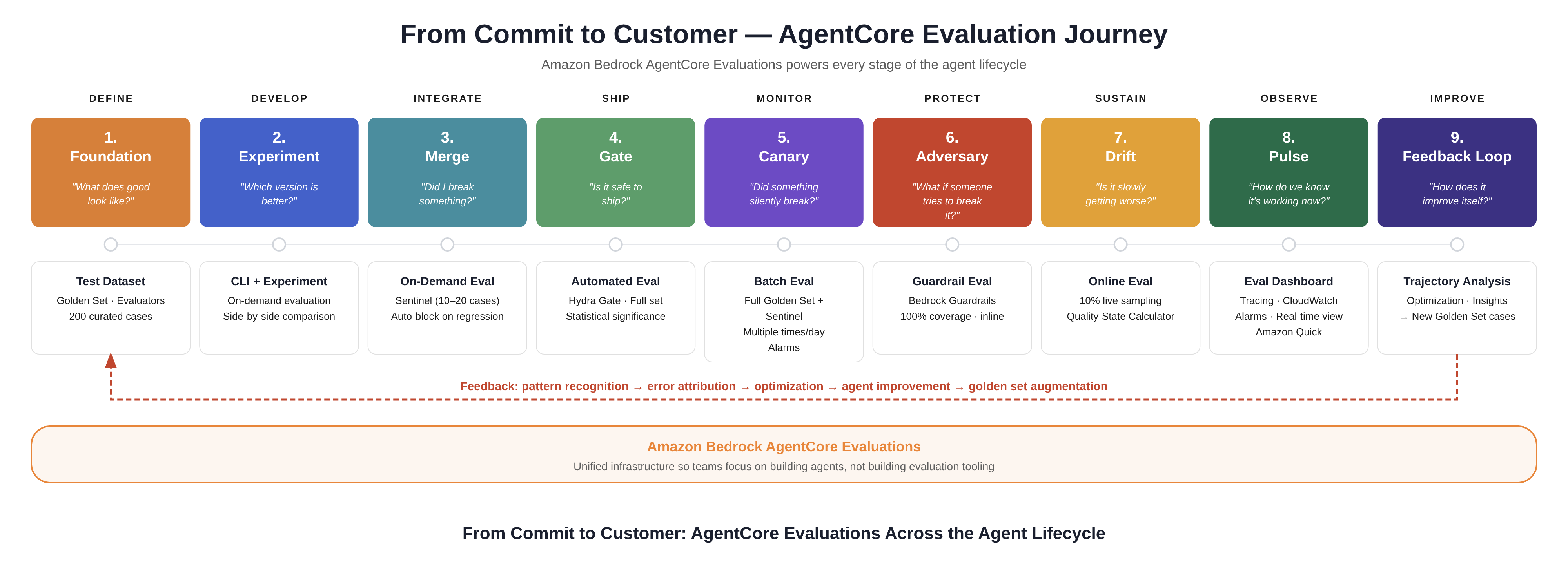
The nine stages of the agent lifecycle, from initial commit to live production, address common questions faced by teams as their agents evolve.
The Agent Lifecycle and the Nine Common Questions
Teams developing production agents encounter the following questions as their agents mature:
Stage 1: The Foundation: “What does good look like?”
Stage 2: The Experiment: “Which version is better?”
Stage 3: The Merge (CI): “Did I break something?”
Stage 4: The Gate (CD): “Is it safe for production?”
Stage 5: The Canary: “Did something silently break?”
Stage 6: The Adversary: “What if someone tries to break it?”
Stage 7: The Drift: “Is quality drifting in live?”
Stage 8: The Pulse: “How do we know it’s working right now?”
Stage 9: The Feedback Loop: “How does it get better automatically?”
We create a unified framework for each stage of the agent lifecycle using AgentCore Evaluations. The nine stages are interconnected points on a continuous evaluation surface, powered by AgentCore Evaluations from initial commit to production response.
Source: AWS Machine Learning Blog